
Keegan's North East
Alex Niven offers his thoughts on how and why Kevin Keegan had such an impact - beyond just football - on the people, culture and identity of the North East of England.
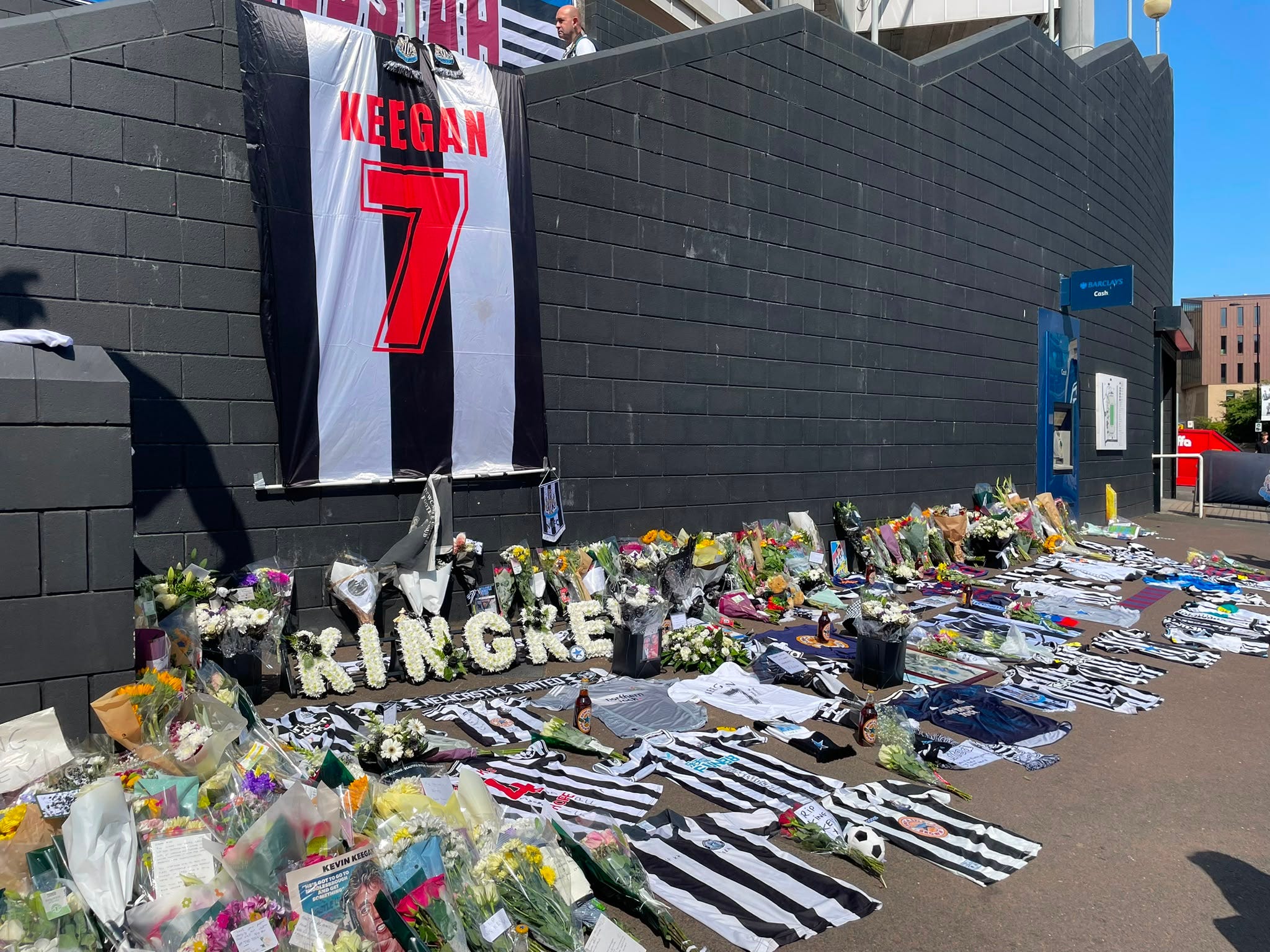
One grey day in February 1992, as we were putting on our coats after lunch, the school dinner lady Gail Watson walked through the door with a beaming look on her face. Gail had helped us to organise proper football matches at breaktimes a couple of years earlier, at the peak of the 1990 World Cup and the Gazza moment.
For this and many other reasons, we loved her. She also lived right next door to the Newbrough First School canteen, and had just overheard a radio bulletin on a quick trip home. ‘I’ve got some news,’ she said. ‘Kevin Keegan is the new Newcastle manager.’
It might sound absurd to describe this as a ‘where were you when JFK was shot’ moment. But people from the North East will know what I mean by this. Keegan’s replacement of Ossie Ardiles in early 1992 was an era-defining moment on several counts. Most important of all was that it kick-started the headiest, most euphoric and downright unusual episode in the region’s modern history.
At the centre of the story was Keegan himself, of course. But first we should remember the context in which his arrival as our ‘Messiah’ (scarcely a hyperbole) occurred. An area defined by its extraordinary industrial history, Tyneside had suffered a near-terminal hit to its sense of self in the 1980s, when the long process of ‘deindustrialisation’ reached a devastating climax. Unlike other cities where this was also the case (notably, and ironically for our purposes, Liverpool), Newcastle had a football team that seemed to embody the backdrop of socio-economic decline that dominated the long 1980s.
The third most successful side in English football history by 1970 (behind only Aston Villa and Man United), the Toon began a drastic downward spiral in the late 1970s and early 1980s, as a series of unfortunate manager and line-up changes combined with financial mismanagement and the misdeeds of a brainless ownership. It just so happened that at almost exactly the same time, Margaret Thatcher was coming to power and taking a sledgehammer to the ailing heavy industries that had been the heartbeat of the North East.
Keegan was not an especially political figure (though he made no bones about his dislike of Thatcher herself). But the key thing about his story is that he arrived in Newcastle at a time when people felt that they needed to be rescued (or rather, if we are following the biblical metaphor, when they wanted to be led out of the wilderness).

In his first spell at the club, which ended a few weeks after the start of the Miners’ Strike in 1984, he hauled the club out of the second division and inspired younger generational talents like Waddle and Beardsley to be the players they were capable of being.
His second spell, this time as manager from 1992 to 1997, would be even more deserving of elaborate Geordie praise. Backed by the more booster-ish ownership of the Hall family, and at a time when political prospects were looking slightly more hopeful, Keegan once again brought out the latent potential in the Newcastle team and its impassioned fanbase. The ‘Entertainers’ side, and its thrilling assault on the summit of the new Premier League — climaxing with the near-miss of 1996 and the now heavily meme-ified ‘Love It If We Beat Them’ rant — were the spectacular outcomes.
But there was more going on here than this potted summary suggests, as anyone who experienced the Keegan era both knows and is likely to find hard to explain to outsiders. Even if we accept that Keegan was basically bringing hope to a marginalised region in a difficult phase of its history by way of an entertaining football team, this still doesn’t fully account for the atmosphere he seemed to generate in 1990s Tyneside — for the phenomenon of the Keegan years, if you like.
This was a time when samba bands started playing at Greys Monument on Saturdays, lights appeared on the Tyne Bridge (first switched on by KK himself), and Newcastle was named alongside New Orleans and Rio de Janeiro in a list of the world’s top 10 party destinations. Not all of this was down to Keegan himself of course. But people who were there at the time will tell you that he somehow seemed to be at the heart of it all, that the energy propelling the city into this new and more exciting version of itself seemed ultimately to emanate from what Keegan was doing at an ecstatic, revived, frequently carnivalesque St James’s Park. If there was a sound that hung over everything in these years, it was: ‘walking along, singing our song, walking in a Keegan wonderland’.
Other commentators will be able to rake over and analyse the nuances of Keegan’s (incredible) playing career — and indeed the tactical ins and outs of various stints as a manager at Newcastle, Man City, Fulham, and England. But in the North East we somehow have to account for the fact that Keegan was, if not our literal messiah, then certainly the most consequential regional hero we have had since the height of industrial period, and something like a spiritual embodiment of much of what we found ourselves thinking and feeling in the last two decades of the twentieth century.
What was this? I think it has something to do with a comment made by former NUFC defender John Anderson in the wake of Keegan’s passing yesterday. For Anderson, who also played in the 1984 promotion team, Keegan ‘made you believe you were better than you actually were’. There is a stereotype that Geordies are cynical, pragmatic types who accept their lot and try to make the most of it, whether in football or politics or the trenches of everyday life. In lots of cases this might be true. But I think that Keegan showed us that we have another side to ourselves.
Beyond all the disappointments, failures, and tragedies we see around us every day, there is another region, a better region, and believing we are good enough to find it is the first step in getting there. This is what KK taught us.
Alex Niven
@Alex_Niven
Lovely piece, Alex. Thanks so much for writing it for us. That wider sociological perspective is definitely a vital part of the story.
You hit upon something at the end. I'm essentially a miserable pessimist. But football also sometimes makes me a hopeless dreamer and romantic. Both are embedded in us.
I guess Dan Jackson would have something interesting to say about that and the Northumbrian mentality.
Brilliant writing, my thoughts exactly, I’ve been trying to tie how he lifted the region outside of football and relating that to politics without it going off track.. you did it perfectly..