
Review: Morbo - Phil Ball
A journey through the many beefs of Spanish football.
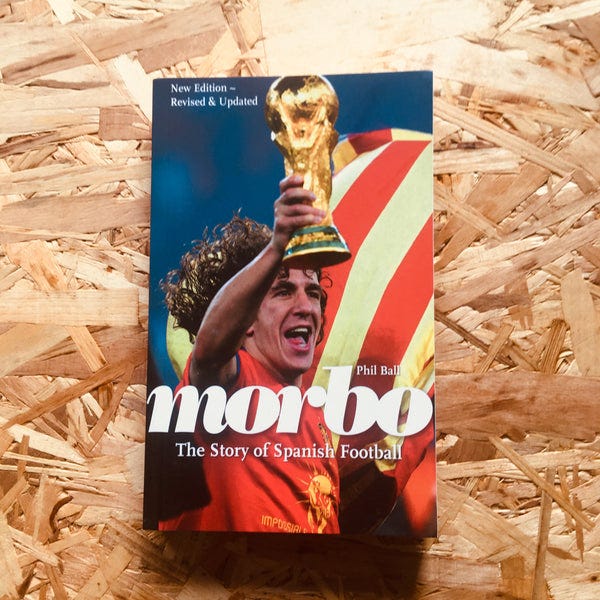
Written relatively early in the millennium this book (original version) misses the dominance of Guardiola’s tiki-taka Barcelona with Messi, Xavi, Iniesta et al as well as Spain eventually fulfilling its massive potential as an international force but it is still mightily worth reading.
Some explanation of the book’s title (Morbo) might be a decent starting point. Fundamentally and I can feel the hot breath of fluent TF Spanish speakers (Norman Riley and John Milton) on my perspiring neck Morbo might be best translated into English as rivalry. But I think it has an altogether deeper meaning in the Spanish context, diverting into political, cultural and regionalist dimensions throughout the entire history of the game in Spain.
Its a clever narrative tool the author, Phil Ball uses as a historical device to describe the story of the Spanish game at club and international level over what by anyone’s estimation has been a tumultuous period in history.

The Spanish Civil War and the fascist Franco-led dictatorship looms large within the history of the game as you might expect but Ball’s detailed knowledge of Spain’s game and national story allows him to debunk some myths which predominantly centre around the Morbo of Real Madrid and Barcelona. On this subject there are side-swipes of criticism for fellow author, Jimmy Burns and his tome Barca, whom he insinuates overeggs the Barcelona pudding with the grandiose claims made for the Catalan giant.
As you might expect The Real-Barca Morbo forms a large part of the subject which is fair enough given their story is the biggest in Spanish football. However, Ball dives deep into equally as interesting tales of Athletic Bilbao’s Basque rivalry with Real Sociedad and different takes on the famous Cantera or Basque-only policies. Additionally there are interesting passages on Athletic’s differing relationships with Real and Atletico Madrid.
These are compelling stories but its possible as a football fan to have absorbed all of this information from elsewhere and that’s why I found the new ground of the Morbo between Real Betis and Sevilla in particular. But there are others involving the likes of Valencia, Deportivo, Celta Vigo which paint a vivid picture of a football culture heavily seasoned with the deep regionalism of the country.
The book was published by the long running magazine, When Saturday Comes back when hard-copy everything was still viable so those of you who read WSC might recognise it from the regular advertisements it had in its pages.
I read this book not long after it was published and enjoyed it but probably appreciated it more after pulling it off my bookshelves for the first time in something like twenty years.
There are a few mentions of Newcastle United which I’d forgotten about from my first reading - namely how our club most closely resembles a Spanish club, probably Athletic Bilbao, given our distinct Geordie identity, separateness and distance from the capital.
Our UEFA Cup game with Athletic back in 1994/95 gets a mention as does our invitation in 1924 as FAC holders to act as the opposition for the opening of a certain stadium in Madrid, home to Real and known nowadays in short-hand as Bernabeu.
Prior to its re-naming after WW2 it had always been known as Nuevo Estadio Chamartin.
There’s also a mention for Sunderland but that is to comprehensively dismiss some of the spurious claims made by weirdoes down there that they somehow had a kind of contribution to the formation of Athletic Bilbao and the choice of their colours and kit. This is utter nonsense as Ball succinctly explains … attributing the Basque club’s kit to a desperate club official purchasing a set of R&W shirts from an outfitters in … Southampton as he’d been unable to get his hands on Athletic’s original colours which were similar to Blackburn Rovers on a trip to England.
Why are those Mackems so desperate to insert themselves into that club’s history?
Its a good book and I’d highly recommend it as a starting point for an outsider’s view of Spanish football (Ball at the time wrote as an Englishman living in Spain - San Sebastian where he had become something of a dedicated follower of Real Sociedad, determined to bring up his son in the Los Txuri-Urdin tradition) but I’ll be keen to return to the subject, particularly after reading Los Leones which we have reviewed for this here doings.
A good book and you’ll like it if you’re stirred yourself to get to the end of this review of it I’d guess.
Michael Martin, @TFmick1892.bsky.social
Click on the image above if you want to buy the book
I’ve read this a couple of times - the last time must be a good ten years ago.
I dug it out again a couple of weeks ago with a view to reading it.
Highly recommended.
Great book! You've inspired me to go and dig it out again. This and Brilliant Orange by David Winner are two of my all time favourites.